The run-up
Several years ago, near the end of 2022, CheckMate was still only an idea. Then came the decision to pitch this idea to an audience in the form of better.sg’s wonderful volunteer community. That sparked a wild journey over the next two years.
2023: We formed a team of volunteers around a vision - To be the trusted, efficient and accessible scam and fact-checking service - run by the community, for the community. We then built and iterated on the first version of CheckMate.
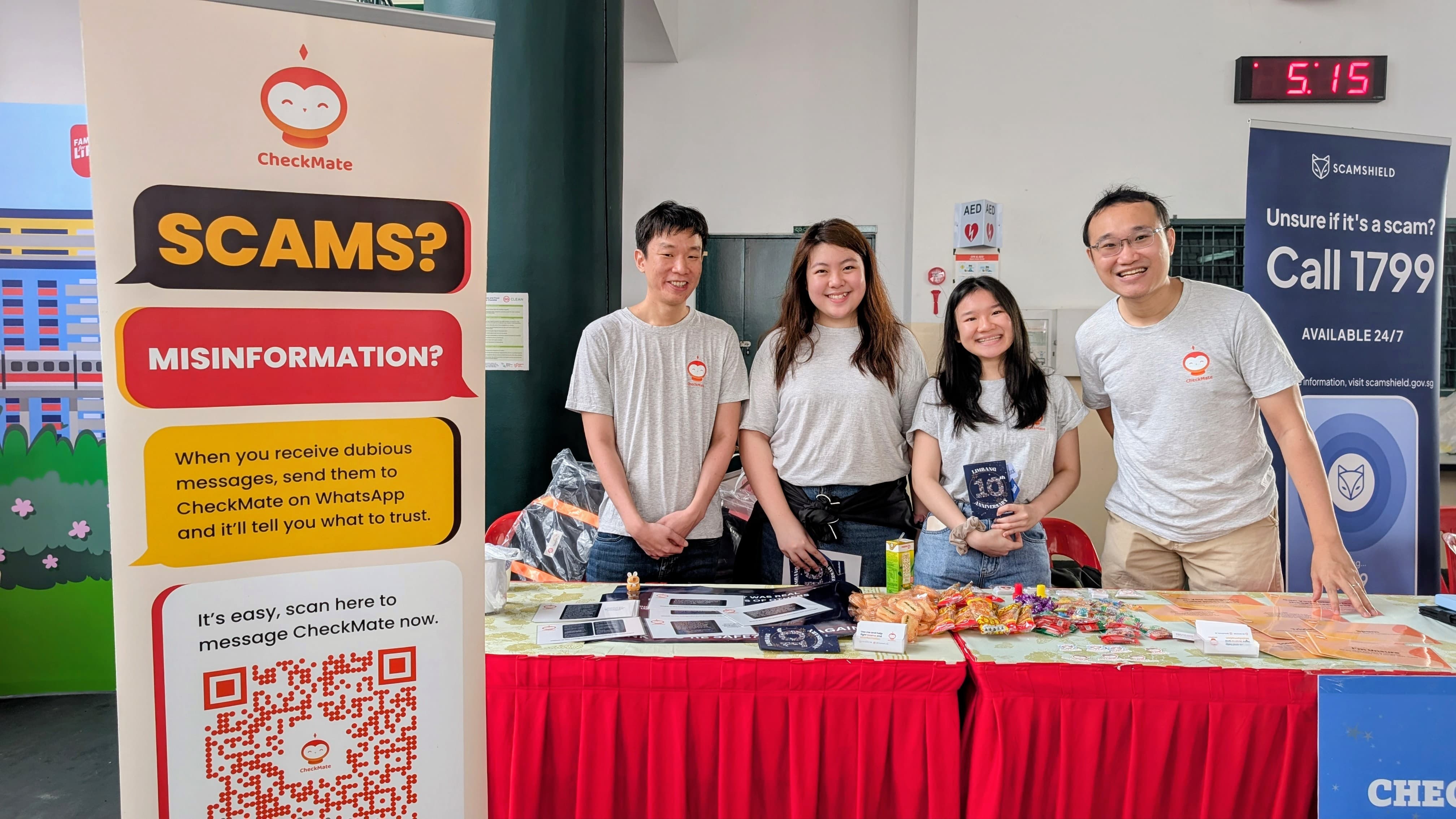
2024: CheckMate started to gain more traction and mindshare, with news coverage, and presence at various roadshows and programmes, conducted in conjunction with the National Library Board. We grew our community and established our own volunteering programme. Despite this, it became clear that the first iteration, based on crowdsourcing, had shortcomings that limited the impact that we could create. Also, as we began to think about scaling, we found it a challenge to access government grants or philanthropic funds, as a ground-up initiative with an idea that was more of a tech product than a conventional programme.
Our goals for 2025
As 2025 came round, we aimed to do a few things in the year ahead:
Develop a new operating model for fact and scam-checking. In this model, AI would verify submissions, and the community we had built up would check the AI instead.
Build an ecosystem around this product, where people sent in messages to be verified, volunteers and learners provided oversight over the AI (while getting better at distinguishing scams and misinformation) and the data collected being shared with as many parties as possible, while also improving our AI systems.
Finding a scalable business model amidst this ecosystem that did not rely on government or philanthropy to fund.
Together with 3, to “graduate” from a ground-up initiative into a formal entity that could receive revenue, funding etc.
One year on, it’s timely to reflect on what we’ve done, and where we’ve come for each of these goals.
2025 Review
Developing a new AI-driven operating model
At the start of 2025, agentic AI systems were getting increasingly capable. The hypothesis was that this might make a new operating model for fact and scam-checking feasible. We set about proving this hypothesis.
By Q1 2025, we had developed and internally tested our CheckMate agent that currently powers our WhatsApp service. In Q2, confident in its accuracy, and with crowdsourcing adding an additional human layer of checks over the AI, we went live. We also participated in the AI Verify Foundation’s Global AI Assurance Pilot, pairing up with Advai from the UK to perform adversarial testing on our new system, with heartening results. The rest of 2025 was spent working on developing a framework that would help us evaluate and improve our AI system more effectively. All things considered, we’ve managed to prove that a system combining AI with crowdsourced-based human-over-the-loop is a feasible approach to fact and scam-checking.
That said, challenges remain. The AI still gets things wrong on occasion, especially when it’s a developing story where official information is scarce. A “human-over-the-loop” element, currently provided via crowdsourcing, continues to be necessary to mitigate this risk. Furthermore, information threats keep evolving, and so too the web landscape. As an example, we continually have to change up how we extract content from webpages to research claims, as more and more sites move to block automated crawlers.
Verdict: Largely successful, though keeping the AI system up to date proved more difficult than expected. Reliance on our crowdsourced human-over-the-loop also proved hard to eliminate.
Building an ecosystem of value creation
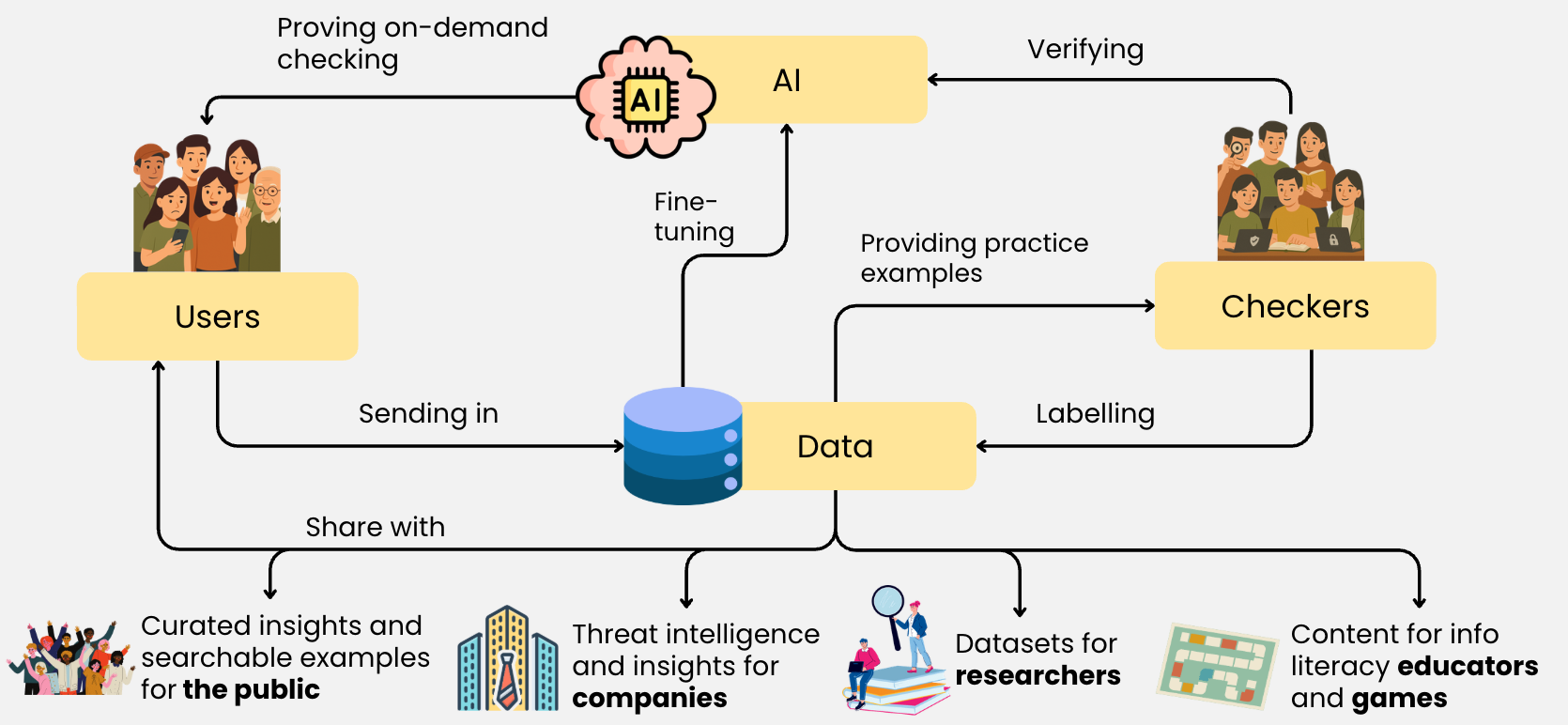 The CheckMate ecosystem we want to build towards
With the AI in place, the theory was to create a flywheel of value incorporating the AI, our users, our checker volunteers and our data. To this end we:
Started to share selected checks on our website, while making them searchable by anyone
Shared data with Prof Edson Tandoc and his team at NTU, as examples used in their Fake News Detective game
Partnered with Carol Soon (PhD) on the NUS module, GEX1032, Fake News in the Public Sphere, where students submitted examples of misinformation to CheckMate and critiqued the responses.
Wrote our very own white paper on virality, based on an analysis of the data we received.
While the core flywheel clearly works, and these initiatives demonstrated the potential for value creation, the scale of this ecosystem is still small. And as at end 2025, we’re still searching for the means to scale it up meaningfully.
Verdict: Some successes at a small scale, and we continue to create some impact - but unable to scale up the ecosystem meaningfully.
Figuring out business model
To scale this ecosystem, we needed a viable business model. When CheckMate began as a ground-up project in 2023, there had been no intent to operate it as a business, or inkling that it might turn into one. CheckMate’s first iteration, an indie initiative built around volunteer crowdsourcing, was so cheap to run that there was no need to think about financial sustainability. But as we tackled attempted to grow our impact, and as AI became an integral part of the operating model, it became apparent that we’d need a viable business model to be able sustain and scale the initiative. To me, this was the most important thing we’d have to figure out in 2025.
The first 7 months was a whirl as we explored the possibility of running CheckMate as a social enterprise:
Joined cohort 12 of the SUSS Venture Builder Programme to learn how to build an impact business
Started a crowdfunding campaign to test people’s willingness to contribute to CheckMate
Did market research to explore people’s willingness to pay for CheckMate as a B2C product, both for themselves or for others
Spoke to a bunch of businesses to explore B2B possibilities in areas like threat intelligence, or a CheckMate API
Went to the Startup x Innovation Thailand Expo 2025 to pitch and explore overseas interest/potential in the product
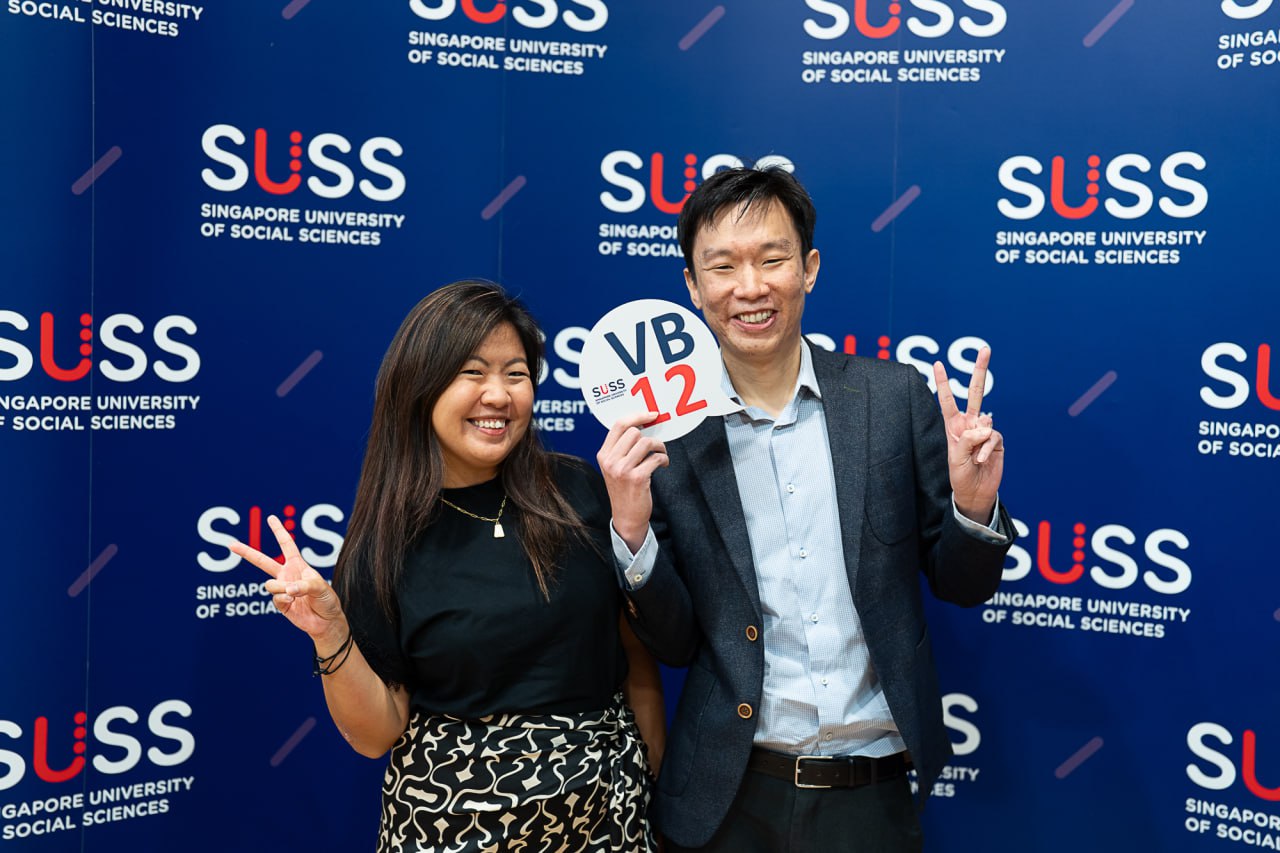 Us at the SUSS VB12 Demo Day
Some of these were promising, others less so. But ultimately, at the end of 7 months, the base case was that in its current (predominately B2C) form, CheckMate was unlikely to attract much investor interest. Feedback was often one of these 3 themes:
Unlikely that customers will pay for this kind of service, which is more “vitamin” than “painkiller”
Too much of “public good” to be profitable
Capabilities too adjacent to what commercial chatbots like ChatGPT or Claude could already do
More concrete pathways to revenue seemed to exist in the B2B space. Specifically, there seemed to be demand for bespoke anti-fraud/authenticity verification solutions for companies. However, this felt like too far a turn away from the current form of CheckMate, with its community angle and aim to validate a new operating model for fact/scam checking. It felt almost like starting a new company.
Eventually, at the end of July, we incorporated CheckMate as a non-profit. In our minds, this best allowed us to stay true to the community, the volunteers, and the original concept, while also opening up the possibility of charging for products and services provided, and allow us to go beyond market research and test actual customer interest. We’d give up the possibility of venture investment, but it wasn’t like there was strong interest anyway.
Over the next few months, we:
Launched B2C monetisation, allowing people to buy checks and gift them to others
Worked with a wonderful group of students from NUS Accounting, and Professor Pasha, to brainstorm and explore alternative revenue sources
Pitched CheckMate at a technology summit in Detroit, as part of the Young Southeast Asian Leaders Initiative
That said, despite what felt like a significant milestone at the time - making our first revenue a week after launching B2C monetisation - we’re currently still far from making enough revenue to sustain a full-time team.
Verdict: Still yet to figure out a business model that would allow us to scale meaningfully.
Graduating from a ground-up initiative
Prior to 2025, we’d been tapping on infrastructure from better.sg to run our product as an incorporated ground-up initiative. This was invaluable to get us started, and we’re now huge advocates for the value of better.sg. But, to experiment with monetisation and business model, we first had to become our own entity. This finally happened in July 2025, as we incorporated a non-profit company limited by guarantee - CheckMateSG Ltd. This turned out to be much harder than starting a private limited company, but by Q3 we had set up the necessary structures.
As a non-profit, we also managed to get ourselves a bunch of discounts for SaaS, including Slack, Google Workspace, Canva, Langfuse, Github Enterprise, Workato and others. These enabled us to keep our expenses really low, while providing our volunteers with the tools they needed to contribute effectively (Granola was a particular favourite).
Thankfully, thanks to these discounts, and with an unconventional tech-stack leveraging Cloudflare’s wonderful free tier, we’ve managed to keep operating expenses really low, affording us runway to pivot or try new things in the future, despite not yet figuring out a working business model.
Verdict: Successful - we’re now our own entity that can sustain current (albeit small) levels of usage and impact.
Where we’re at today
Admittedly, we fell short of where we hoped to be at the end of 2025. That said, at the end of this yearslong journey, we’re still our own non-profit, with the ability to keep things going at current levels and try some new things so long as we're able to attract volunteers and other forms of creative resourcing. We also learnt so much about business, product development, AI, and how they all interact.
Some key lessons
Business
While it sounds wonderful in theory, it’s really hard to build a core offering - in our case the B2C, AI checking product - that both delivers social impact and is also profitable. Much more feasible would be cross-subsidisation, where profits earned elsewhere subsidises impact.
We should have tested willingness-to-pay earlier on, before building up something so substantive. By 2025, with volunteers involved, a small community of checkers built up, and having been talked up in the press, pivoting in the search of revenue started to feel like a let down of the original ethos.
We got quite substantial media coverage, and won several awards, which felt like progress at the time. But we realised that those were more indicative of story-market-fit, not product-market fit. No one pays for the story!
AI
AI opens up possibilities to radically transform the way things used to be done. In our case, it’s fact-checking, a field that had always relied on hard-to-scale experts and bespoke analyses.
That said, getting out the first version of an AI system was actually the easy part. Improving it, once in production, was where the true difficulty lay. This required significant thought about how to evaluate accuracy, safety, and quality, and how such evaluations can be incorporated into the development process. Without this, AI performance soon hits a wall. Even for us, this is still a work-in-progress.
Especially for a system such as CheckMate’s, it’s not possible to think of the AI as a “one-and-done” thing. Continuous tweaking is needed to keep up with changes in the input distribution, like evolving scam modalities and accessibility to website sources.
AI and cloud truly makes it possible to do a lot with very little. CheckMate now comprises a web app, a whatsapp bot, a telegram bot, an AI agent, and an API server, of which AI played a significant part in creating. Outside tech, website design, copy, images, translations, were all done by AI as well. Claude code is truly a drug!
AI confers so much leverage that in modern knowledge businesses, it becomes essential to identify/grow teammates who can work well with it.
Running a non-profit in Singapore
It’s amazing how challenging it is to set up a non-profit (a.k.a company limited by guarantee) in Singapore even without the intent for it to become a charity. Getting a corporate secretary, creating bank accounts, drafting a constitution - all these were much harder than if we were a private company. Thankfully, we managed to get that done in the end. Do reach out if you’re trying to do the same!
There’s a lot of support provided to non-profits by big SaaS providers, and intentionally designing processes around these helps keep costs low. As an example, we used to be on Lark Suite, when they offered a generous free tier for 50 members. All our volunteers loved it! But after they downgraded the free tier, we migrated to a combination of Slack and Google Workspace, both of which provided free access to non-profits.
What’s next for CheckMate
With the lessons under our belt, and with CheckMate now established as a small non-profit with low operating expenses, we aim to do a few things in 2026:
Clearly segmenting the non-profit (B2C in Singapore) and for-profit (B2B) tracks, deprioritising the latter till we’ve got a team that’s more ready for it.
Making our checker's experience better, and improving the value proposition that CheckMate offers our volunteer checkers, a smaller but consistently dedicated group.
Shifting CheckMate's centre of gravity away from helping people check things using AI, towards scam and fake news reporting, collecting more data, and using it to issue preemptive warnings and drive other value streams. This changes how we go about our mission, but might be even more effective at scam prevention, while incurring less marginal cost and risk.
Properly open-sourcing the code to our AI verifier so that others might further improve, or find a better use for it. This is new to us, so any help would be welcome.
Let us know if you’re interested to contribute to any of these initiatives!
No doubt it’s been a trying 2025, as we tried many things and learnt lessons the hard way. While there's plenty we'd do differently, there’s also very little that we regret along the journey.
Here’s to another year of learning and growth in 2026!
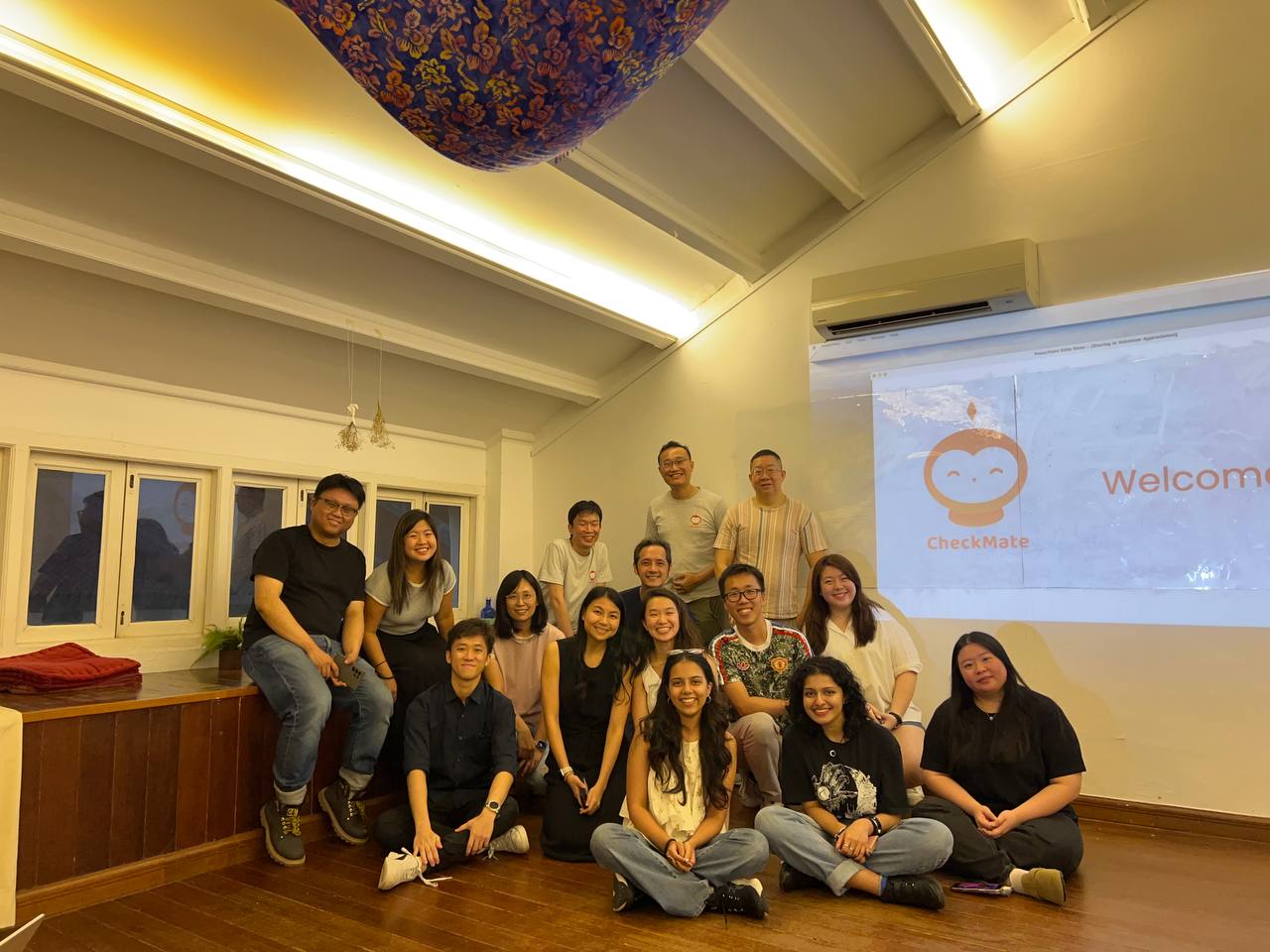 Some of the folks from our wonderful CheckMate community